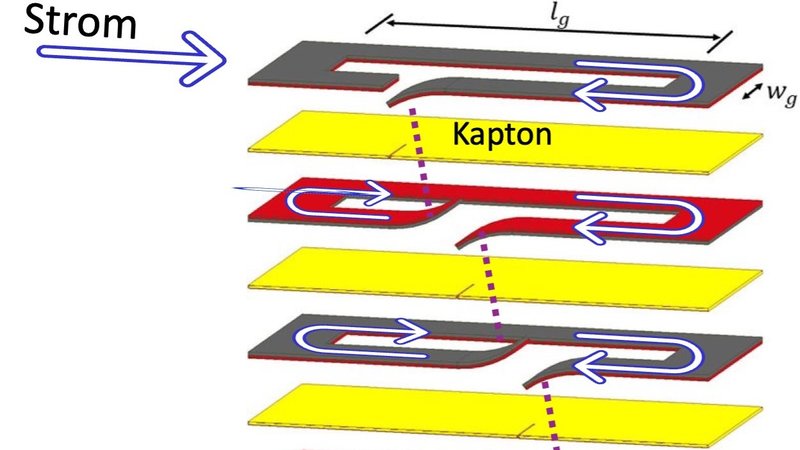
Together with @KIT (Institute for Technical Physics), we are developing compact superconducting high-field magnets based on YBCO tape stacks. Our innovative DUDA project is receiving funding from the German Federal Ministry for Economic Affairs and Energy's Central Innovation Program for SMEs (ZIM).
What is it all about? Superconducting magnets have become indispensable in medicine and science. The established YBCO pancake coils are limited in terms of further miniaturization due to the bending radius of their ribbon conductors. With DUDA coils (Disk-Up-Down-Assemble), a novel, patented coil configuration made of YBCO ribbon stacks, an unprecedented miniaturization of YBCO coils can be achieved. Compact DUDA coils would enable a higher resolution of the NMR signal in the now widely used NMR spectrometer tabletop devices. In rotating electric motors, the high air gap field of DUDA coils would lead to a significant increase in performance compared to motors based on conventional permanent magnets.
What exactly is DUDA? DUDA describes a novel, optimized coil configuration. The ribbon conductors are stacked, with contact made via the HTSL side of the ribbon conductors. The HTSL sides of the ribbon conductors face alternately upwards and downwards. This is where the acronym DUDA comes from: Disk-Up-Down-Assemble. These compact YBCO DUDA coils made from YBCO tape stacks generate high, controllable magnetic fields from transport currents. In our project, we are investigating both rectangular and ring-shaped coils with this innovative configuration.
The highlight: this new radial arrangement of the coils offers technical, economic, and ecological advantages. The homogeneity of the superconductor in the radial direction leads to lower shear stresses compared to conventional coils. Heat can be dissipated more effectively from the inside of the coils to the outside, ensuring better thermal stability. Another advantage is the modular design, which allows individual modules to be tested for weak points before installation. In ring-shaped DUDA coils, we expect maximum magnetic fields to be approximately three times higher than in conventional coils with the same transport current.
Jens Hänisch is the project manager at KIT. Dibin Joussey is leading this exciting project on behalf of evico.